There is something about a passenger train that still feels orderly in a hurried world. A train has a schedule, a route, a destination, and a rhythm. It does not ask every traveler to become a driver, navigator, parking attendant, and baggage handler all at once.
For many Americans, passenger trains occupy two different places in the imagination. One is nostalgic: polished coaches, dining cars, conductors, depots, and long views through wide windows. The other is practical: commuting to work, reaching an airport, visiting family, attending a ballgame, or getting from one downtown to another without building an entire day around traffic.
The interesting thing is that both ideas can be true. Passenger rail can honor the memory of an earlier America while still serving the needs of a modern one.
The train was once the front door of town
Before the interstate highway became the dominant symbol of mobility, the railroad depot was often the front door of a community. People arrived by train for school, work, courtship, military service, business trips, funerals, and family reunions. A town with a depot was connected to the wider world in a visible way.
Those stations were not simply transportation buildings. They were civic markers. They told travelers where the center of town was. Hotels, diners, warehouses, post offices, banks, and Main Street businesses grew around them. The arrival of a passenger train was an event, even if it happened every day.
"She came down from Birmingham
One cold December day
As she rolled into the station
You could hear all the people say
There's a girl from Tennessee
She's long and she's tall
She came down from Birmingham
On the Wabash Cannonball"
In 1986 I met Roy Acuff backstage at the Grand Ole Opry. Acuff didn’t write the song—it dates back to the late 1800s—but his 1936 (the year before my father was born) recording transformed it. With his high, clear voice and fiddle leading the way, he turned a wandering folk tune into a signature anthem of early country music. For many listeners, his version became the definitive one.
It’s one of those rare cases where a performer and a song become inseparable. You hear the opening line, and even today, you can almost see Roy Acuff on stage, fiddle tucked under his chin, sending that imaginary train down the track once again.
I didn't tell Roy that when I spent Saturday nights at Mama Thomas' house that we didn't listen to the Opry on the radio, we watched Lawrence Welk on the television set.
Why the idea feels relevant again
Modern life has not become less mobile. Families, jobs, schools, hospitals, and airports are spread across larger regions than ever before. The question is not whether Americans will travel. The question is whether every trip should require one person in one vehicle fighting the same traffic at the same time.
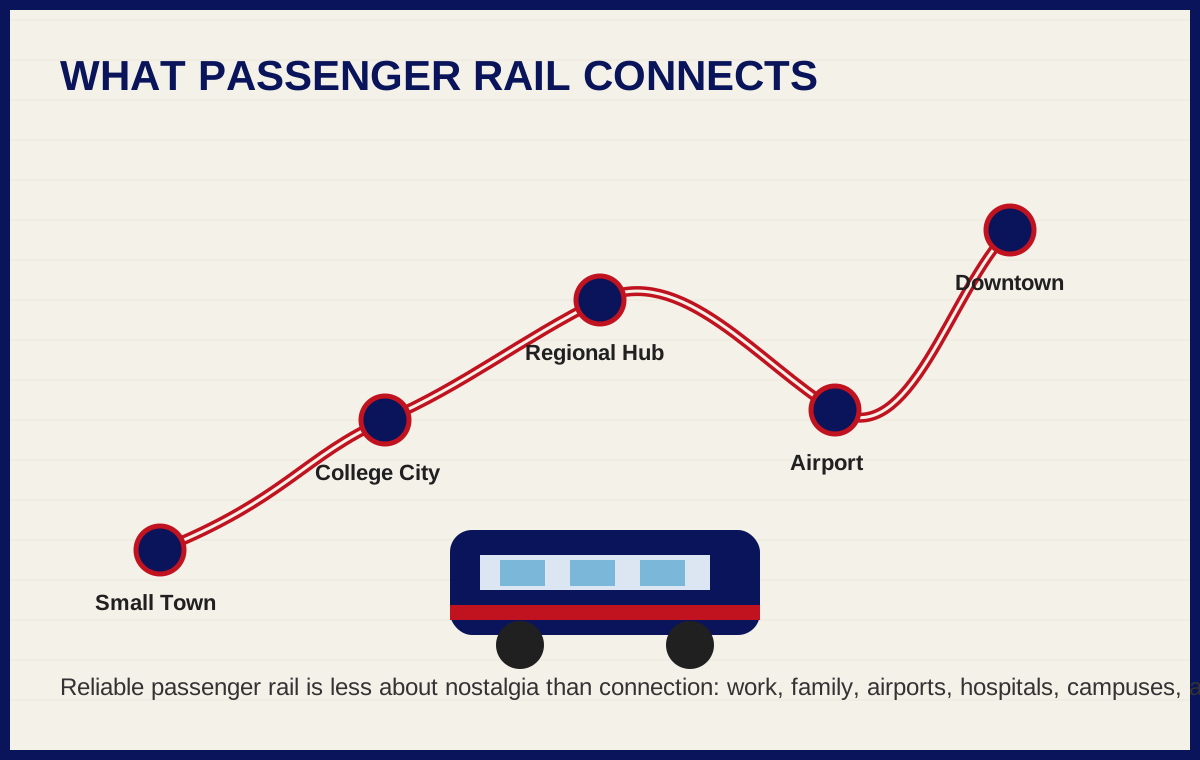
Passenger rail works best when it solves a real route problem. It does not have to be romantic to matter. It has to be reliable, clean, safe, reasonably frequent, and easy to understand.
The overlooked comfort of not driving
One of the quiet advantages of a passenger train is that time on board is not the same as time behind the wheel. Driving demands constant attention. A train ride gives some of that time back. A traveler can read, work, make a call, look out the window, or simply sit still for a while.
That sounds small until you compare it with the wear and tear of a long day in traffic. A two-hour drive in rain, construction, and congestion is not the same experience as a two-hour ride where someone else is responsible for the route.
Downtowns need arrivals, not just exits
Passenger rail also changes how a city receives people. Airports are usually outside the center. Interstates tend to move travelers around cities as much as into them. A well-placed train station can put a visitor near hotels, restaurants, offices, museums, theaters, ballparks, and public spaces.
What makes passenger rail work?
That is what the city of Huntsville, Alabama wants to know. Huntsville is spending $350k to see if rail transport is feasible. I can tell them this much for free. Frequency, reliability, clean stations, clear schedules, safe parking, easy ticketing, realistic travel times, and useful connections at both ends. The train itself is only part of the experience.
Nostalgia is not enough
It is tempting to sell passenger trains with sepia photographs and sentimental language. Visit Chattanooga! There is nothing wrong with memory. Memory gives the subject warmth. But nostalgia alone cannot carry the argument. People will use trains when trains serve real needs.
The best future for passenger rail may not look exactly like the past. It may be a blend: modern equipment, practical schedules, restored stations, downtown access, regional corridors, airport connections, and enough civic pride to make the experience feel like something better than an afterthought.
The American habit of rediscovery
Americans often rediscover old ideas when the new system becomes too complicated. Front porches return as people tire of isolation. Main Streets return as people tire of sprawl. Local food returns as people tire of sameness. Passenger trains may be another example.
The train reminds us that progress is not always a straight line away from the past. Sometimes progress means recovering a useful idea and adapting it to modern conditions.
That is why the passenger train still has a story to tell. It is not only about steel wheels and polished rails. It is about how people move, how communities connect, and whether travel can still include a measure of togetherness and common destination.
In a nation forged by motion, the passenger train endures as the most nostalgic way to chase the horizon.

Greg Cook is a CPA and writer in Alabama. He writes about business, technology, memory, collecting, and the practical details that connect ordinary life to larger American stories.