
There are some places that live on long after the buildings are gone. Opryland is one of those places. For people who visited Nashville in the 1970s, 1980s, and 1990s, the name still carries a particular feeling: music drifting from open-air theaters, the hum of rides, families planning their day around both roller coasters and live shows, and a sense that the whole place belonged to Nashville in a way no generic amusement park ever could. Opryland was fun, certainly, but it was also something more. It was a stage-driven park tied directly to the music business, and because of that it became a place where performers could sharpen their craft before moving on to bigger opportunities.
Opryland USA opened on May 27, 1972, as part of the broader Opryland complex developed by WSM, Inc., the company behind the Grand Ole Opry. Two years later, in 1974, the Grand Ole Opry itself moved from the Ryman Auditorium to the new Opry House nearby. The park and the Opry House together helped shift a large piece of Nashville tourism out toward the Cumberland River and Briley Parkway. In later years the area would also include the Opryland Hotel, creating an entertainment district that mixed country music, tourism, and hospitality in a way that only Nashville probably could have pulled off.
From the beginning, Opryland was promoted less as a conventional amusement park and more as a musical showpark. That was not marketing fluff. Unlike parks that built their identity around a handful of giant rides, Opryland built its reputation around stages, singers, bands, dancers, costume changes, and tightly run live productions. Yes, there were rides. Kids remember the coasters, the flume, and the train. Adults remember the landscaping, the themed sections, the shops, and the feeling that there was always another show starting somewhere just around the corner. But the heart of the place was live entertainment.
Opryland worked because it did not try to be a copy of somewhere else. It felt like Nashville, sounded like Nashville, and gave young performers the kind of daily repetition that turns raw talent into stage craft.
Why Opryland mattered
That live-performance focus is what made Opryland historically important. Theme parks often hire singers and actors, of course, but Opryland occupied a different place in the culture because it sat inside the orbit of the Grand Ole Opry and Music Row. It was not just another job in entertainment. It was a practical bridge into the Nashville business. A young singer could perform several shows a day, six days a week, in front of paying audiences, while also trying to meet songwriters, musicians, agents, publishers, or producers in the same city after work. There are not many environments better designed for developing stage discipline.
The park demanded consistency. A singer could not rely on one magical Friday night performance and coast on that memory for a month. Opryland required stamina. The audience changed constantly. Families came in from all over the South and from well beyond it. Some wanted old country, some wanted gospel harmonies, some wanted comedy, and some simply wanted to sit down for thirty minutes in the shade and be entertained. Performers had to win over all of them. That kind of repetition teaches timing, projection, crowd awareness, and professionalism in a hurry.
For that reason alone, Opryland deserves a place in country music history. It served as a proving ground, not in the romantic sense of a single life-changing audition, but in the practical sense of hundreds of performances that hardened talent into skill. Anyone who has spent time around musicians knows that skill is often what separates the promising from the durable.
The many musicians who came through its stages
Because Opryland employed so many performers over the years, its alumni network is broader than many people realize. Some artists passed through quickly. Others spent multiple seasons there. Not every performer became a household name, but enough of them did to make the pattern unmistakable. Opryland helped prepare people for larger careers in country music, Christian music, background vocals, television, and the general Nashville entertainment industry.
Among the performers associated with Opryland before or during their rise were people such as Lorrie Morgan, who performed there early in her career before her recording breakthrough. Steve Wariner also had Opryland ties during his early Nashville years. Later-era Opry and touring vocalist Marty Slayton has said she came to Nashville specifically to sing and dance at Opryland USA while attending Middle Tennessee State University. Ty Herndon likewise performed there as a teenager in the cast of Today's Country Roads before wider recognition followed. Cynthia Rhodes, better known to many as a film actress and dancer, also performed at Opryland before Hollywood roles came her way.
That list is not exhaustive, and that is part of the point. Opryland was not a one-off launching pad for a tiny, glamorous handful of artists. It was a system. It gave hundreds of performers steady work and real audiences. Some became stars. Some became elite supporting musicians or vocalists. Some built successful careers in songwriting, production, or live performance. The common thread was that Opryland gave them a place to learn how to do the job at a professional level.
The shows were the engine
What made that possible were the shows themselves. Opryland offered an enormous range of productions over its life, including country revues, gospel-centered shows, patriotic programs, bluegrass sets, comedy-driven presentations, and seasonal productions. The exact show lineup changed over time, but the structure remained the same: polished productions, frequent performances, and a very high value placed on entertainment quality. In a sense, Opryland ran on set lists and call times as much as it ran on ticket lines.
For visitors, that meant the park felt unusually alive. Instead of treating music as background decoration, Opryland placed music front and center. That fit Nashville perfectly. It also gave the park a broader appeal than one based only on thrill rides. Parents, grandparents, and younger children all had plenty to enjoy. Even people who were not coaster enthusiasts could spend the day happily moving from one venue to another, hearing bluegrass in one part of the park and a large theatrical production in another.
That blend of entertainment also reflected the broader identity of Nashville itself. Country music sat at the center, of course, but the city has always been more musically varied than outsiders sometimes imagine. Opryland understood that. The park could tip its hat to country tradition while still drawing on gospel, pop, folk, and theatrical variety-show traditions. It was more layered than people who never went there often realize.
The Grand Ole Opry connection
The Grand Ole Opry connection mattered immensely. Even though Opryland was its own attraction, it drew authority from its association with the Opry brand. Once the new Opry House opened in March 1974, the whole complex became a statement about Nashville's confidence in its future. The old Opry would honor tradition. The new complex would expand the audience. Opryland was part of that future-oriented vision. It made country music tourism bigger, more commercial, and more family-oriented, but it did so without fully losing the local character that gave it credibility.
For performers, that proximity mattered. Working at Opryland meant working in a place intimately connected to one of country music's most famous institutions. Even if a park job was not glamorous, it was still a meaningful foothold. It put artists in Nashville, onstage, on schedule, and in view of industry people who came through the area. Sometimes a career starts with a giant break. More often, it starts with staying in the room long enough for the right person to notice.
A place in personal memory
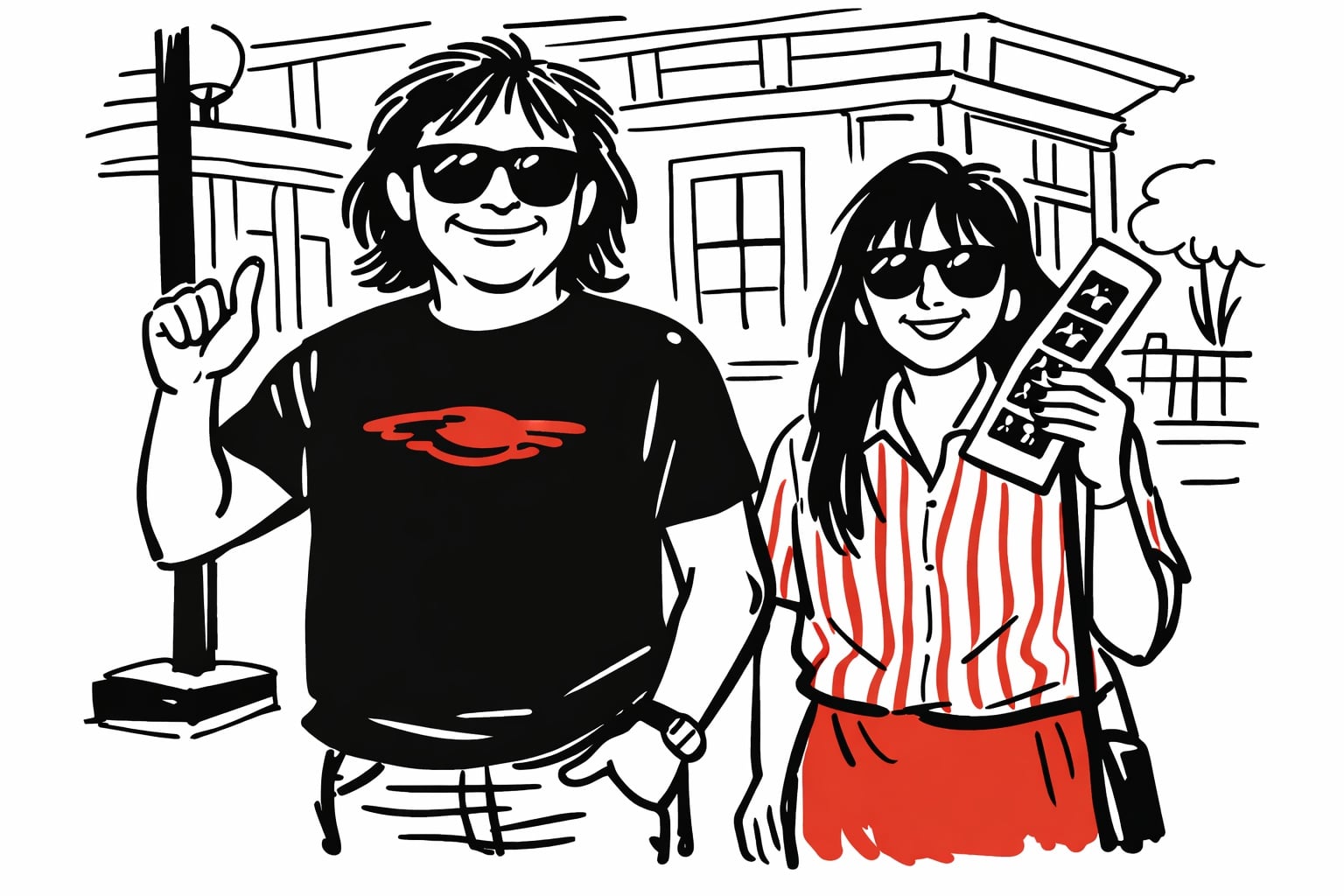
For many of us, Opryland belongs not only to music history but to personal history. My own Nashville memories reach back to a time when Opryland still formed part of the city's personality. The photo of Pam and me in Nashville in 1993 sits squarely in that era. That image is not an Opryland publicity shot; it is something better than that. It is personal evidence of a Nashville moment. Looking at it now, I think about how many people carried home similar memories from those years. Opryland was woven into family trips, anniversaries, weekends away, and ordinary vacations that became less ordinary simply because they happened there.
That is another reason the park still gets talked about with such affection. It was not only a tourist destination. It attached itself to people's lives. Someone remembers a first trip to Nashville. Someone else remembers seeing a future star before anybody knew the name. Someone remembers the train, the water rides, the smell of summer pavement, or the sound of harmonies rising out of one of the theaters. The place created emotional residue, and that is not easy to do at scale.
The closure and what was lost
Opryland closed at the end of 1997. The site later became Opry Mills, a project shaped by a different set of economic assumptions and a different vision of what visitors would support. From a business standpoint, people can argue the decision forever. From a cultural standpoint, something valuable disappeared. Nashville lost a place that had united entertainment, tourism, and artist development in a distinctly local way.
When Opryland closed, the city did not just lose rides and theaters. It lost a pipeline. The park had quietly trained performers for years. It had given audiences a chance to hear excellent live music in a casual setting. It had also offered a version of Nashville that felt both polished and accessible. Once it was gone, there was no true replacement. The Opry remained. Nashville kept growing. New venues came and went. But Opryland's specific combination of family park, musical workplace, and developmental stage never really returned.
Its legacy in Nashville and country music
Today, Opryland survives mostly in photographs, souvenirs, old maps, stories told by former employees, and the memories of those who visited. Yet its legacy remains larger than nostalgia. It helped prove that live music could anchor a theme-park experience. It supported Nashville's growth as a destination city. It gave thousands of tourists a friendly, distinctly regional introduction to country music culture. Most important for this article, it gave a remarkable number of performers a disciplined environment in which to grow.
Some of those performers went on to chart records. Some joined major tours. Some became respected background singers, musicians, and entertainers whose names are better known inside the business than outside it. Some moved from park audiences to the Opry itself. Their careers differed, but the early lesson was often the same: be on time, know your material, give the crowd a show, and do it again tomorrow. There are worse foundations for a life in music.
So when people remember Opryland only as a lost amusement park, they leave out part of the story. It was that, yes. But it was also a working musical institution wrapped inside a family attraction. It helped shape performers. It gave Nashville another stage. And for a quarter century it offered a particular blend of excitement, professionalism, and regional character that would be hard to reproduce now.
That is why Opryland still matters. It mattered to families. It mattered to tourists. It mattered to Nashville. And it mattered to musicians who were still learning who they might become. A place like that deserves to be remembered not merely for what stood there, but for what began there.
About Greg
Greg Cook is an Alabama CPA, Army veteran, and longtime student of Southern history, country music culture, and the places that carry personal memory long after they disappear from the map.