The Breakout Zone is where a trader learns the difference between anticipation and confirmation. Price may be pressing against resistance, but a breakout is not real just because it looks ready.
Lessons from Experience
What I Avoid – Lessons from Overtrading
I’ve tried the complicated setups—more screens, more tools, more noise. None of it improved my trading.
The biggest improvements came from simplifying. Removing distractions. Focusing on what actually matters.
See the Simple Setup I Use InsteadAs an Amazon Associate, I may earn from qualifying purchases.
The best breakouts usually give clues before they move. Price compresses below resistance. Volume dries up. The range tightens. The coil begins to build. But the actual trade is not the guess. The trade is the break, the retest, and the confirmation that buyers are willing to defend the new level.
The Setup
Price compresses below resistance. The stock keeps pressing into the same ceiling, but sellers are no longer pushing it down with much force. Volume dries up and the range narrows. That compression is the market storing energy.
A breakout may be loading, but it still has to prove itself. A chart can look strong and still fail if the move has no participation behind it. The setup is the compression. The signal is the break with volume and a clean retest.
The Rule
Volume confirms direction. Without volume, it is just noise wearing a disguise.
The retest matters because it turns old resistance into a decision point. If price breaks above resistance and then holds that same area on the pullback, the market is giving evidence that buyers have accepted the higher level.
That is where the risk becomes definable. The entry is no longer a hopeful chase into a green candle. It is a planned trade against a level that has already been tested.
The Mistake
The common mistake is buying the breakout candle on impulse with no volume confirmation. The candle looks exciting, the price is moving, and the trader feels the fear of missing out. But excitement is not a strategy.
When a breakout runs without volume, it can reverse quickly. A trader who bought emotion now has no clean stop, no clean thesis, and no reason to stay other than hope. That is how a breakout setup becomes a failed chase.
The Principle
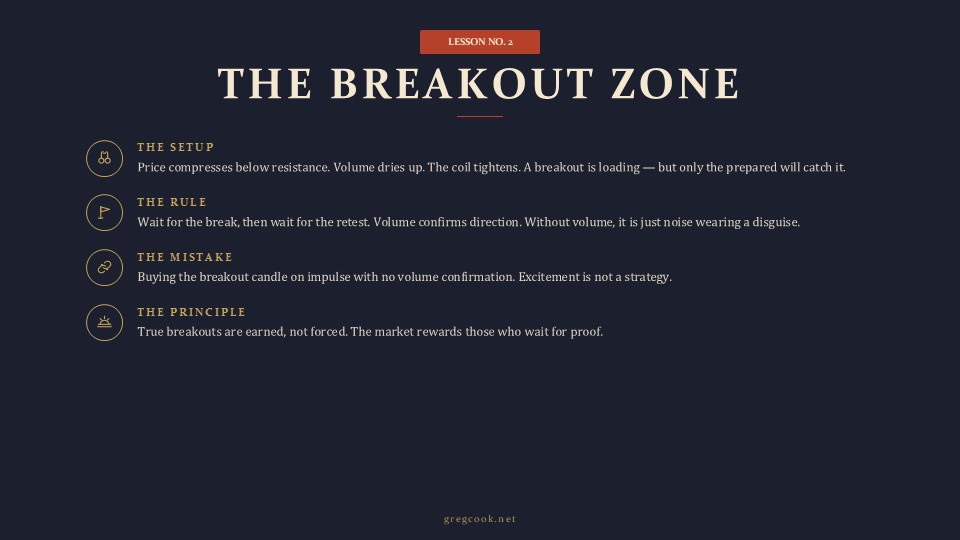
The Setup
Price compresses below resistance. Volume dries up. The coil tightens.
The Rule
Wait for the break, then wait for the retest. Let volume confirm direction.
The Mistake
Do not buy the breakout candle on impulse with no volume confirmation.
The Principle
True breakouts are earned, not forced. The market rewards those who wait for proof.
Field Notes
For my own trading, this lesson is about refusing to force the move. A stock can be near a breakout and still not be ready. The trader’s job is not to predict every move. The job is to recognize when the move has enough evidence to justify risk.
The cleanest breakout trade has three pieces: a known resistance level, a volume-supported break, and a retest that holds. Without those pieces, I would rather miss the first move than buy a weak breakout and donate money back to the market.
