The Stop Loss is not a suggestion and it is not a confession of failure. It is the trade plan doing its job. Before you enter, define your exit and know exactly where you are wrong.
A stop loss protects more than one position. It protects your capital, your judgment, and your ability to come back tomorrow with a clear head. Small losses are the cost of staying in the game.
The Setup
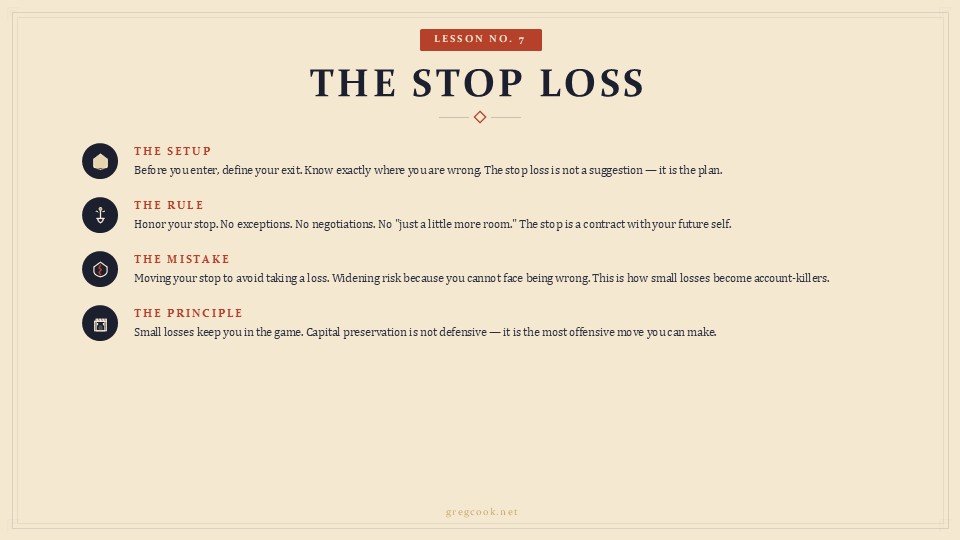
Before you enter, define your exit. Know exactly where you are wrong. The stop loss is not a suggestion — it is the plan.
This means the stop belongs to the setup, not to your emotion after entry. If the trade only works because you keep moving the stop farther away, the trade has already failed.
The Rule
No exceptions. No negotiations. No “just a little more room.” The stop is a contract with your future self.
The rule is simple because it has to be. A stop that gets debated in real time is no longer risk management. It becomes hope management.
The Mistake
The mistake is moving your stop to avoid taking a loss. Widening risk because you cannot face being wrong is how small losses become account-killers.
Every trader gets stopped out. The damage comes from turning one controlled loss into a larger, undefined problem.
The Principle
This is part of my full trading setup →
The Setup
Define the exit before the entry. Know the exact level that proves the trade wrong.
The Rule
Honor the stop. No exceptions, no negotiations, and no emotional rewrites.
The Mistake
Moving the stop turns a planned loss into uncontrolled risk.
The Principle
Small losses keep you in the game. Capital preservation is an offensive move.
My Trading Desk
The Exact Setup I Use Daily
A stop loss only works if you can think clearly before the trade turns emotional. My desk setup is built around clarity, discipline, and fewer distractions.
This is the trading desk setup I use to plan entries, define exits, and stay accountable when the market starts moving fast.
See My Trading Desk Setup on AmazonAs an Amazon Associate, I may earn from qualifying purchases.
Field Notes
For my own trading, the stop loss is the line that keeps a trade from becoming a story. I want to know where I am wrong before I risk the money, not after the screen starts moving against me.
The cleanest trades are easier to manage because the exit is already decided. The stop gives the trade room to work, but not room to become a problem.
