The VWAP Dip Buy is one of the cleanest intraday setups because it gives a trader a defined location, a logical stop, and a reason to act before the trade feels obvious to everyone else.
VWAP (Volume-Weighted Average Price) is the average price of a stock for the day, adjusted for how much volume traded at each price. Think of it as the market’s “center of gravity.”
When price is above VWAP, buyers are in control. When price pulls back to VWAP, it often acts as a decision point — support in an uptrend, resistance in a downtrend.
Trading Desk Setup
Trading Around VWAP – Tools That Keep Me Patient
VWAP trading requires patience, clear charts, and fewer distractions. This is the core setup I use to watch VWAP pullbacks, wait for confirmation, and avoid chasing late entries.
See My VWAP Trading Setup on AmazonAs an Amazon Associate, I may earn from qualifying purchases.
VWAP is the market’s intraday mean. When price pulls back toward VWAP on declining volume, the question is simple: are buyers still defending the trend, or has momentum failed? The best version of this setup happens when the first controlled pullback meets VWAP and buyers appear without panic.
One thing that helps me stay patient during VWAP pullbacks is using a simple tool like this: the timer I use on my desk . It sounds basic, but it helps slow me down and avoid chasing entries.
The Setup
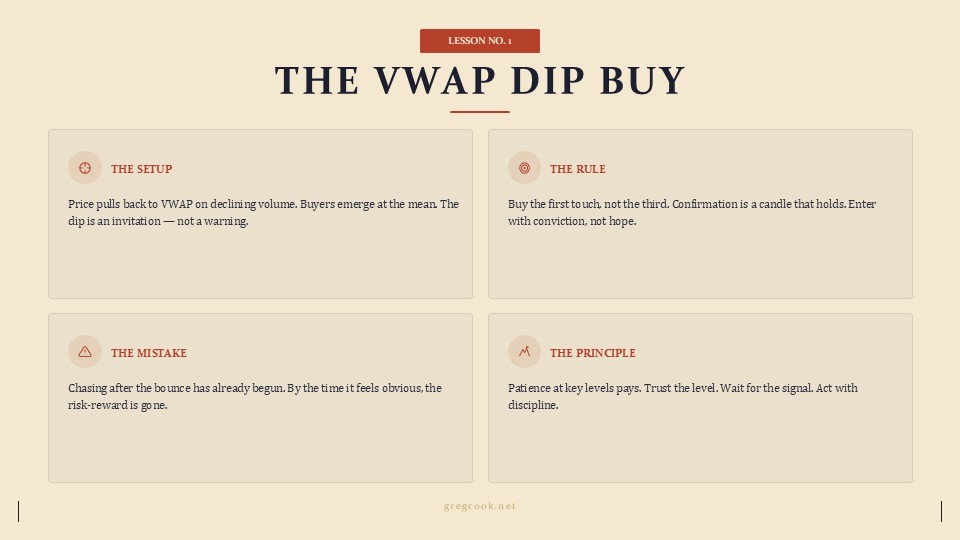
Price is trending higher, then pulls back toward VWAP while volume fades. That matters. A quiet pullback is different from a hard rejection. Declining volume suggests sellers may be losing energy instead of taking control.
The dip is an invitation only if buyers show up at the mean. The setup is not simply “price touched VWAP.” The setup is price touching VWAP, holding, and giving evidence that the level still matters.
The Rule
Confirmation is a candle that holds. Enter with conviction, not hope.
The first touch gives the best relationship between risk and reward because the stop can be close and the upside is still open. By the third touch, the level may be tired. The move may have already been defended too many times.
This is where patience pays. The trade does not begin when the stock is exciting. It begins when the level is tested and the risk can be defined.
The Mistake
The common mistake is chasing after the bounce has already begun. By the time the move feels safe, the risk-reward may be gone. The trader ends up buying the emotional part of the move instead of the planned part of the move.
A late entry also creates a psychological trap. If price pulls back again, the trader is immediately uncomfortable because the entry was too high. A good setup can become a bad trade simply because the entry was undisciplined.
The Principle
The Setup
Price pulls back to VWAP on declining volume. Buyers emerge at the mean.
The Rule
Wait for a candle that holds. The level has to prove itself before the entry.
The Mistake
Do not chase after the bounce is obvious. Obvious often means late.
The Principle
Patience at key levels pays. Trust the level. Wait for the signal. Act with discipline.
Field Notes
For my own trading, this lesson is really about location. I do not want to be buying random strength in the middle of the chart. I want to know where I am wrong before I enter. VWAP gives that reference point.
The setup is strongest when the broader market is supportive, the stock has relative strength, and the pullback is orderly. It is weakest when VWAP has already failed repeatedly or when volume expands against the trade.
